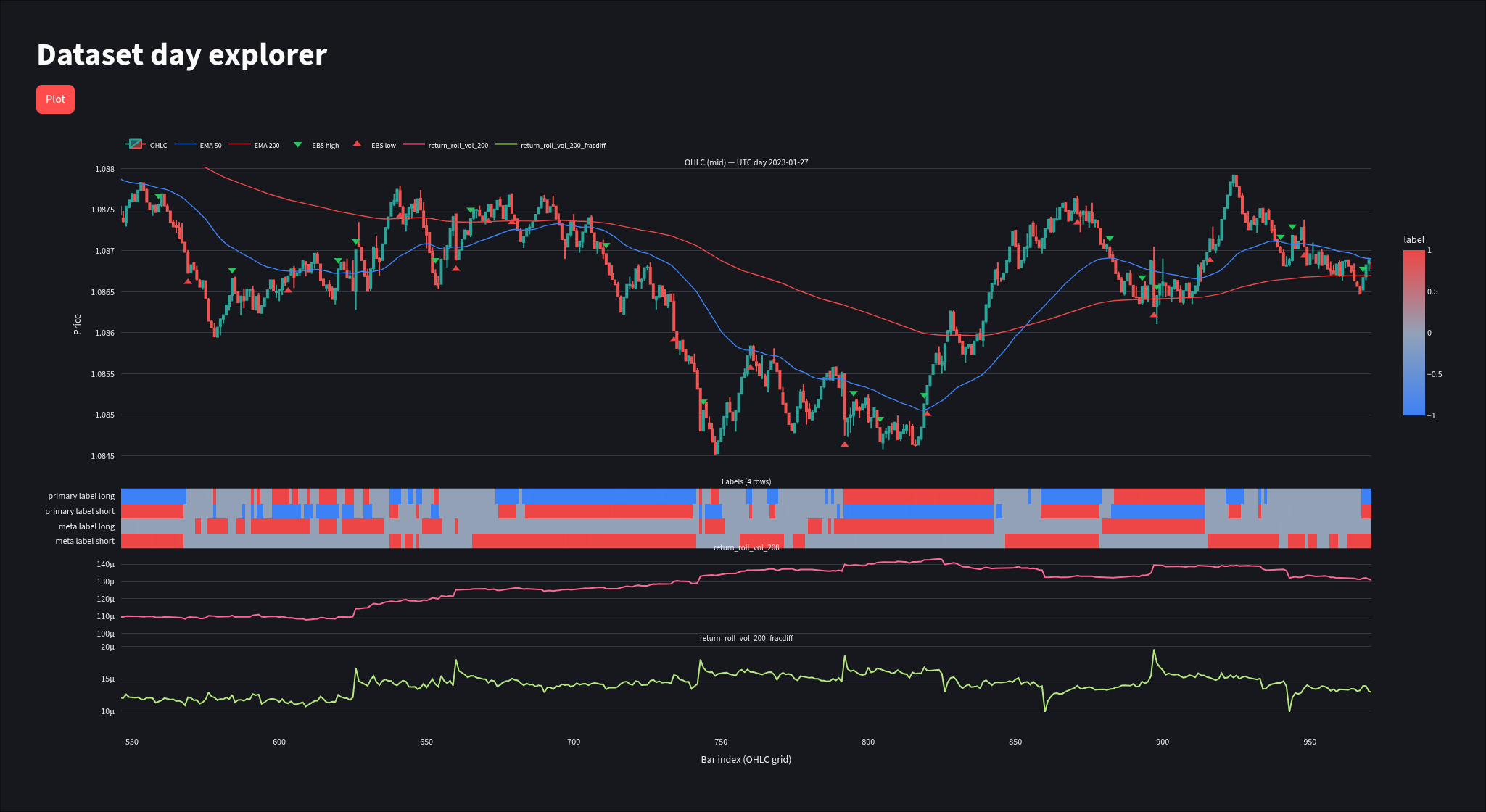
Hi everyone. I should have posted this yesterday, but I felt tired.
I recently implemented some algorithmic rules for event-based sampling for machine learning, and here's how they look on the chart: the arrows show the bars that are sampled. These arrows do NOT mean "trade" or signal entry/exit points; they simply tell us which bars are used to train the model on the training set or when we make a model prediction on the test set. Because we want to use these events to trade, we don't use future data in our event algorithm.
The goal here is to provide our model pipeline with a relevant event when the question arises: "Should we trade or not?" and avoid market noise that we don't want to take part in. We can make an analogy with poker:
Our events are hands where we have a setup and might choose to play (e.g. pocket pairs, suited connectors, or high cards). We don't want to play every hand like a garbage 7-2 offsuit with no setup, and in the case of financial markets, we don't want to trade every bar. Let's take the example of pocket pairs like 5-5, 8-8, or J-J: we can set mine or play them aggressively pre-flop in a heads-up situation (1v1 situation). The event is the pocket pair, while the strategies are set mining and aggressive pre-flop play. For set mining, we need deep effective stacks and a cheap pre-flop call. For aggressive heads-up play, we generally want our opponent's range to contain many weaker hands and avoid too many opponents entering the pot, where our equity can quickly decrease. The effective stack size, the number of opponents, and the strength of our opponent's range can all be seen as features.
Back to financial markets: as retail traders, we don't have to trade all the time. We want to make informed decisions and trade only when we have a potential edge. Don't be afraid of missing opportunities: there will always be plenty of future hands to play and plenty of future events to trade.
I'm not really satisfied with my events yet. There are multiple event algorithms used on the chart, and I will probably drop some of them. I would like something where I can "play tight", so to speak: not necessarily something with a huge edge, but something with a more consistent edge.
Thanks for reading. The poker analogy might not be understandable for people who don't play poker, so don't hesitate to ask me, ChatGPT, or any other LLM.